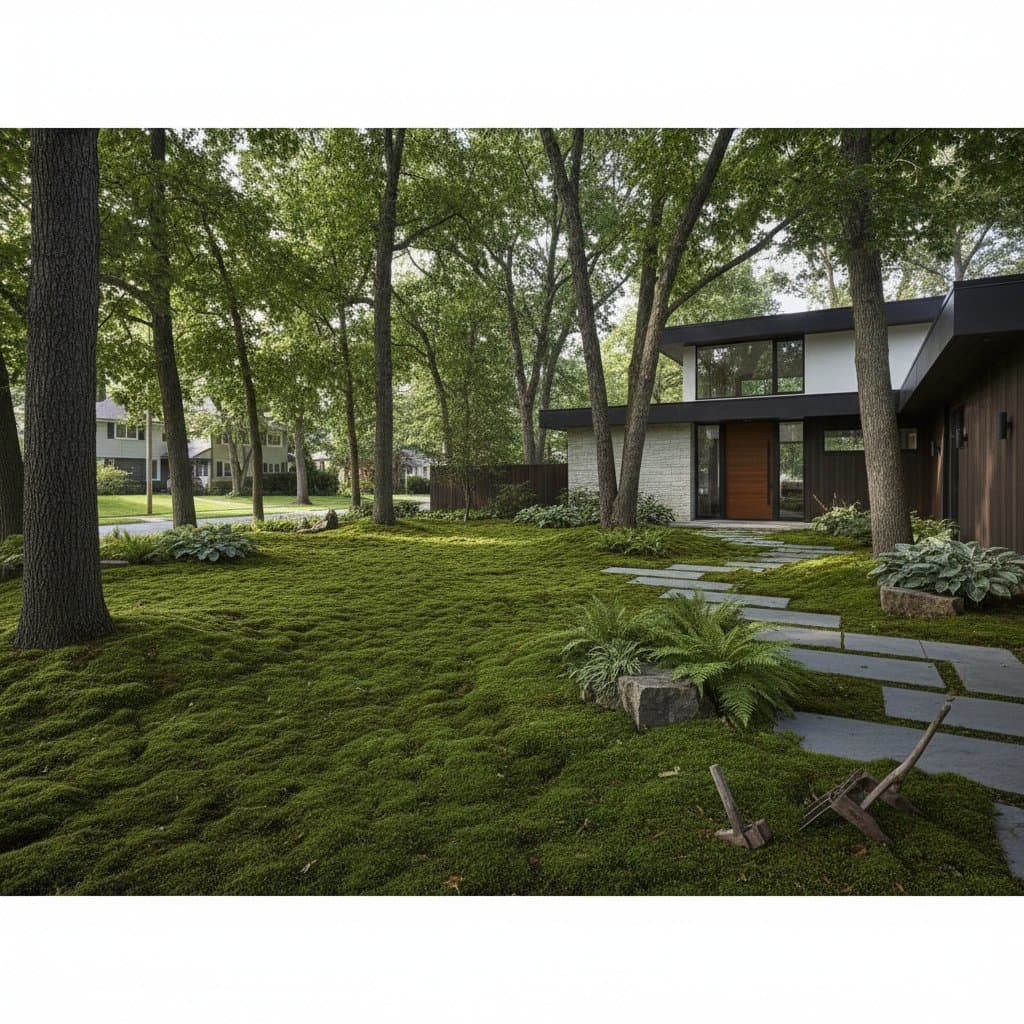
Why Moss Lawns Are Replacing Grass in Front Yards
Many homeowners gaze at their uneven front lawns and question the need for excessive water, fertilizer, and weekend labor just to achieve average results. You share this sentiment with countless others weary of investing resources into grass that resists thriving season after season. The appeal of moss lawns lies in their ability to maintain vibrant green coverage with scant attention, excel in shaded areas, and eliminate the chore of mowing entirely.
Professionals who restore landscapes often encounter clients convinced they follow best practices, yet traditional turf grass proves demanding and ill-suited to typical home environments. Moss flourishes under benign neglect. After establishment, it creates a plush, organic carpet that retains its allure despite imperfect surroundings.
Challenges of Traditional Grass Lawns
Advantages of Moss Over Grass
Moss differs from grass as a non-vascular plant, lacking the need for deep roots or abundant soil nutrients. It draws moisture directly through its foliage, enabling success in humid, compressed, or acidic terrains where grass falters. Its affinity for shade positions it ideally for wooded lots or areas deprived of direct sunlight.
Moss lawns demand negligible chemical inputs. Fertilizers, pesticides, and pH correctives remain unnecessary except in severe cases, yielding financial savings and safeguarding nearby water sources from excess nutrients. As moss expands, it forms a compact layer that suppresses weeds by denying them room to establish. This yields a dependable, verdant expanse year-round.
Environmentally, moss supports biodiversity by hosting small insects and fungi without disrupting ecosystems. Unlike grass, it sequesters carbon effectively in low-light settings and requires up to 80 percent less water annually, aligning with sustainable gardening trends projected to dominate by 2026.
Preparing for Conversion
Before embarking on a lawn transformation, evaluate your property's features. Moss requires consistent humidity and partial shade, rendering it unsuitable for arid, sun-drenched sites. Essential tools and materials include a metal rake for dethatching, a sprayer or misting hose, moss fragments or starter sheets from a reliable supplier, rainwater if available, and a kit to test soil acidity.
Test soil pH initially, as moss favors mildly acidic levels from 5.0 to 6.0. Should readings indicate alkalinity, incorporate elemental sulfur gradually to adjust, monitoring progress over weeks.
Installing a Moss Lawn Step by Step
-
Clear the site thoroughly. Eliminate existing grass, weeds, and debris to ensure moss contacts the substrate directly, whether soil, rock, or firm earth.
-
Scarify the surface lightly. Employ the rake to disrupt the top half-inch without deep tilling, promoting better adhesion on stable ground.
-
Hydrate the prepared area. Apply a fine mist to the soil surface prior to moss placement, facilitating initial attachment.
-
Position the moss. Scatter or lay fragments, overlapping seams modestly to accelerate integration. Secure by pressing down manually or walking softly over the area.
-
Maintain moisture consistently. Deliver daily mists during the initial weeks, adjusting for dry spells. As growth emerges, taper to one or two applications weekly.
Establishment typically spans six to eight weeks, influenced by climate and care diligence. In cooler, moist regions, progress accelerates; warmer areas may necessitate protective shading cloth temporarily.
Addressing Potential Setbacks
Should moss exhibit browning or desiccation, excessive light or insufficient hydration often proves the culprit. Relocate a sample portion to denser shade for observation. Revival confirms solar exposure as the primary concern.
Early weed incursions arise if prior vegetation lingers. Extract them manually with precision, minimizing disruption to the moss. Steer clear of herbicides, which harm delicate moss structures.
Regarding durability, mature moss tolerates occasional foot traffic gracefully. For frequented zones, integrate flagstones or pea gravel pathways to distribute pressure and preserve integrity.
Seeking Expert Assistance
Properties with poor drainage or pronounced inclines benefit from professional intervention. Moss adheres poorly to unstable steep terrains without prior soil reinforcement, such as terracing or erosion barriers.
Sustaining Your Moss Lawn
Established moss demands minimal intervention. Sweep away autumn leaves periodically using a soft-bristled broom or low-powered blower to prevent smothering.
Natural propagation occurs over time, with runners extending to cover voids and densify the mat. To hasten filling, harvest and relocate portions from robust sections to sparse areas during damp seasons.
Annual inspections ensure optimal pH and moisture, but interventions remain rare. This hands-off approach not only conserves effort but also fosters a resilient, evolving ground cover.
Benefits Realized in Daily Use
A moss lawn reshapes outdoor interactions, imparting a serene, tactile quality to the surroundings. It complements diverse architectural styles, from contemporary minimalism to classic cottages, while demanding fractions of the resources grass consumes.
The reclaimed time allows focus on enjoyment rather than toil. Witnessing the persistent vibrancy and simplicity may prompt reflection on prior landscaping choices, affirming the wisdom of this enduring, nature-aligned solution.