Hidden Appliances: Seamless Kitchens Defining 2026
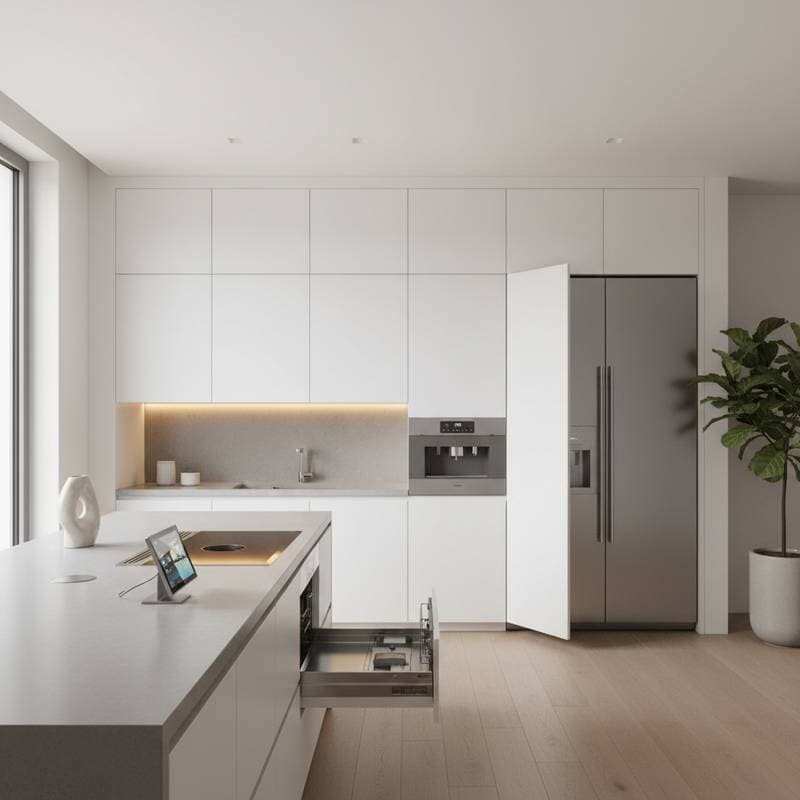
Kitchens once showcased gleaming stainless steel ovens and prominent coffee makers as focal points. Today, leading designs conceal these elements, creating spaces where appliances blend indistinguishably with cabinetry. This evolution became evident in compact London apartments, where innovative storage maximizes limited areas. The approach extends to Cotswolds farmhouses, preserving natural wood and stone textures while promoting overall cohesion and tranquility.
Essential Insights
- Concealed appliances foster a unified, serene kitchen appearance.
- Integrated elements adapt to contemporary urban settings and traditional rural homes.
- Designs enhance usability alongside visual continuity.
- Thoughtful layout and cabinetry choices drive effective implementation.
Cost-effective and adaptable methods suit various living situations.
Reasons for the Surge in Hidden Appliances
Homeowners increasingly seek kitchens that evoke openness and peace. Visual clutter disrupts relaxation after demanding days. Concealing appliances within cabinetry eliminates distractions from lights and cords, expanding perceived space and adding an element of refinement.
Interior designer Elise Grant observes, “When appliances disappear, the kitchen becomes part of the living space rather than competing with it.” This integration suits open-plan layouts, where kitchens connect seamlessly to living or dining areas. Clients frequently select cabinetry that aligns with adjacent furnishings, transforming the area into an extension of the home rather than a isolated utility zone.
Benefits of Integrated Design
Beyond appearance, hidden appliances elevate daily comfort. A refrigerator camouflaged within cabinetry or a dishwasher screened by matching panels shifts the kitchen toward an welcoming atmosphere. Such arrangements streamline routines and reduce the sense of labor.
Even minor adjustments yield notable improvements. Tucking a microwave into a dedicated nook or storing a toaster behind doors declutters surfaces effectively. In one renovation, an integrated refrigerator positioned between pantry units balanced the wall layout. Guests often inquire about its location, highlighting the design's subtlety. For households with children, this setup discourages impulsive access, promoting mindful habits.
Worldwide Adaptations of Seamless Integration
This design philosophy manifests uniquely across cultures. French country homes traditionally embed appliances within cabinetry to maintain historical authenticity. Japanese interiors prioritize efficiency, incorporating sliding compartments that retract small devices when idle. Scandinavian principles emphasize uninterrupted lines, with built-ins aligning naturally to minimalist ideals.
Urban environments amplify the need for such solutions. In New York studios, stacked washer-dryers behind cabinet doors or under-counter mini-fridges preserve order in tight quarters. This strategy applies broadly to city dwellings, from solo apartments to multi-room townhouses, reclaiming serenity amid density.
Professional Guidance for Seamless Kitchen Design
Achieving integration demands precise foresight. Cabinetmaker James Rowe advises evaluating movement patterns first. “Consider daily navigation and frequent-use items,” he notes. “Concealment should enhance accessibility and efficiency, not impede them.”
The following principles, drawn from expert applications, ensure practical outcomes:
- Address ventilation needs. Appliances produce heat and humidity; design cabinetry to facilitate airflow and avoid operational issues.
- Select resilient materials. Panels adjacent to heat sources must resist warping from thermal fluctuations.
- Maintain consistent hardware and surfaces. Uniform elements sustain the seamless effect without jarring interruptions.
- Facilitate upkeep. Incorporate serviceable panels or detachable sections to simplify repairs.
- Manage costs effectively. High-end integrations carry premiums, yet panel-compatible models and layout optimizations deliver comparable results.
Renters benefit from non-permanent options like adhesive cabinet overlays or fabric covers for devices. In a prior London residence, small appliances stored within a lidded freestanding unit replicated built-in cleanliness without alterations.
Merging Smart Technology with Subtle Form
Advancements in connected devices further enable discreet integration. Producers craft units that embed into cabinetry while supporting remote or voice commands. A voice-activated oven resembles ordinary storage until summoned, and flush induction surfaces merge with counters when dormant.
Interior stylist Mariah Benson remarks, “The future kitchen will almost feel invisible, but it will do more than ever before.” This fusion of capability and understatement marks kitchen evolution. Technology integrates as architectural harmony rather than prominent display.
Attaining Seamless Style Affordably
Premium custom work intimidates, yet practical alternatives abound for broader accessibility.
- Incorporate appliance garages. Enclosed countertop units with sliding or swinging doors shelter items like blenders and brewers.
- Standardize color palettes. Neutral-toned small appliances in shades such as matte white or soft gray recede into surroundings.
- Employ selective open storage. Reserve visible shelves for decorative pieces like pottery, concealing utilitarian tools in enclosed areas.
- Adopt modular pieces. Independent cabinets with internal compartments simulate fixed installations sans structural changes.
In a recent home transition, an antique armoire acquired from a French vendor housed the microwave and auxiliary devices. This piece complemented the rustic style while providing equivalent utility to contemporary solutions. Such combinations underscore design's core: merging utility with individual character.
Experiencing the Transformative Calm
Adopting a concealed-appliance kitchen alters interactions profoundly. The orderly setting encourages deliberate cooking, harmonious gatherings, and effortless maintenance. Everything finds a designated retreat, simplifying transitions.
This method bolsters family dynamics through inherent safety and structure. Young children encounter fewer accessible controls, while adolescents internalize organizational norms without overt guidance. The result fosters a nurturing environment that supports well-being.
Steps to Implement Hidden Appliances
Begin by mapping your kitchen's workflow to identify integration opportunities. Consult professionals for ventilation and material assessments to ensure longevity. Start small with garages or modular units, scaling to full customizations as budget permits. These measures create enduring calm, aligning form and function for lasting satisfaction.